
Green transition in Lithuania – Best Practices, Examples and Lessons Learned
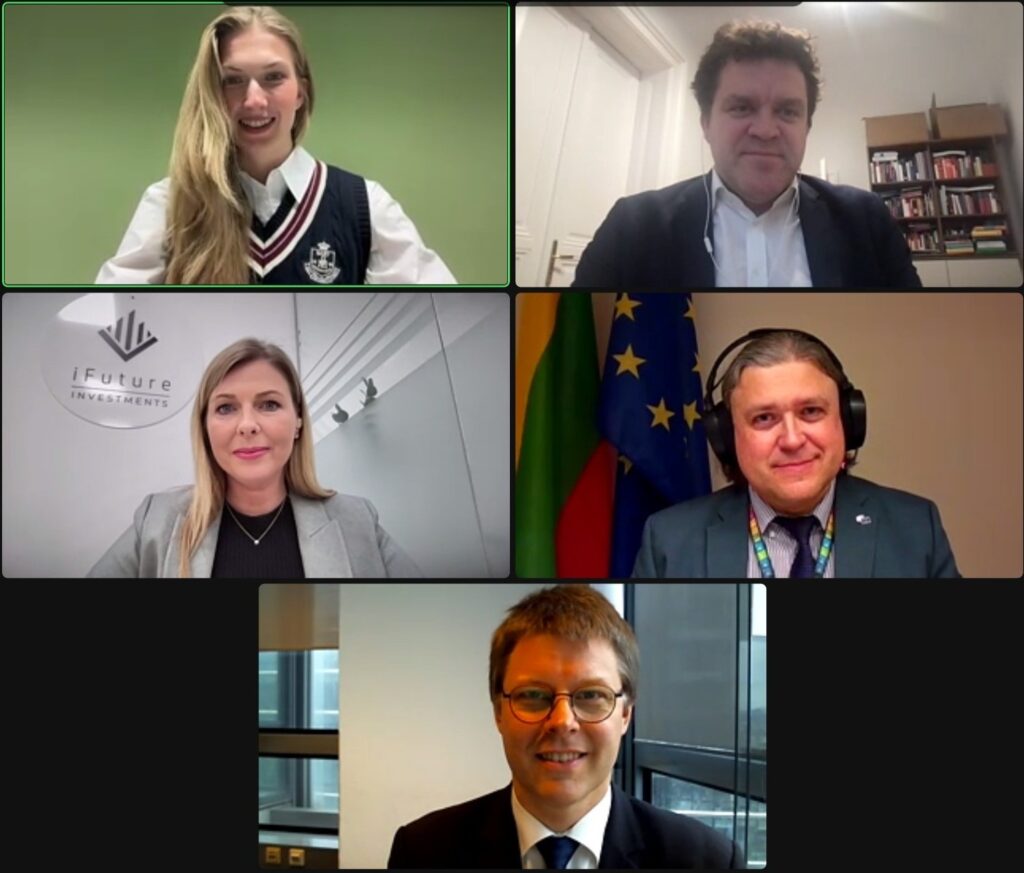
On Thursday December 14th, SME Europe of the EPP, in cooperation with European Foundation of Mittelstand, organized a Webinar on “Green transition in Lithuania – Best Practices, Examples and Lessons Learned”.
The discussion was moderated by Dr. Florian HARTLEB, Political Scientist, Consultant and Expert; Co-founder of the European Foundation of Mittelstand, and saw the participation of Joern GRIESSE, Head of Unit at DG ECFIN, European Commission; Gintarė NARKEVIČIŪTĖ-JURGELIONĖ, Head of Finance and Investment in Lithuania and Latvia, Head of iFuture INVESTMENTS; and Kęstutis KUPŠYS, Member of the European Economic and Social Committee (EESC), Vice President of Lithuanian Consumers Alliance.
Dr. Florian HARTLEB, Political Scientist, Consultant and Expert; Co-founder of the European Foundation of Mittelstand, opened the discussion by stating that the goal is to delve into the Baltic perspective, a region that is often neglected in the broader context. And with this discussion we aim to shed light on critical issues such as the green transition and the green economy, aligning our discussions with significant frameworks like the Green Finance Action Plan.
Joern GRIESSE, Head of Unit at DG ECFIN, opened the keynote speech with introducing the work at the Directorate-General for Economic and Financial Affairs in the Commission and pointed out that, in accordance with the European Semester analysis, the Commission’s recommendations for Lithuania emphasize the need to strengthen healthcare adequacy and improve the planning and delivery of social services. He said that in response to energy market disruptions caused by Russia’s invasion of Ukraine, EU introduced the REPowerEU strategy, aiming to reduce dependency on fossil fuels and Russian energy. Mr. Griesse added that Lithuania’s Recovery and Resilience Plan outlines specific initiatives for the green transition, such as simplifying administrative requirements for renewable energy capacity deployment, financing for offshore wind development and supporting the creation of new storage and production capacity for electricity from renewable sources. The Recovery and Resilience Fund provides support for SMEs, with loans for private investments in solar and wind plants. To conclude, Lithuania’s proactive engagement with the REPowerEU strategy and the strategic allocation of resources in its Recovery and Resilience Plan, positions Lithuania as a front-runner in prioritizing energy security and independence. The opportunities presented in the green transition further the country’s commitment to embracing sustainable practices and economic resilience.
Gintarė NARKEVIČIŪTĖ-JURGELIONĖ, Head of Finance and Investment in Lithuania and Latvia, Head of iFuture INVESTMENTS, continued the discussion and said that Lithuania aims to be the first country globally with model for energy transformation. Reflecting on the past decade’s transformations, she expresses confidence in the government’s capacity to achieve ambitious goals and establish Lithuania as a green finance hub in Northern Europe. While acknowledging the opportunities for SMEs in building solar power plants and renovating buildings, she notes that larger scale projects could have greater potential to include smaller companies. However, she highlights that only 3% of implementing partners in the upcoming wind offshore project are going to be small and medium enterprises. She said that beyond governmental strategies, there is a need to address mentalities in the finance sector. Only a small percentage of clients currently express sustainability requirements for fund management. She suggests increasing financial literacy and educational programs to shift societal perspectives and encourage more sustainable investments.
Kęstutis KUPŠYS, Member of the European Economic and Social Committee (EESC), Vice President of Lithuanian Consumers Alliance, started by addressing concerns about consumer awareness. The alliance conducted surveys in 2018 and 2021, revealing a positive shift in preferences – 46% of Lithuanians express a desire for environmentally friendly investments, showcasing a gradual increase from three years ago. These findings dispel notions of consumer ignorance and highlight the need for accessible instruments for societal participation in the transition. He continued that the majority of respondents express a willingness to accept lower returns on their funds if the investments contribute to positive societal impact. This suggests a genuine interest among the public to prioritize impact over financial gains. Continuing with his statement, Mr. Kupšys emphasized the necessity to reform the fiscal system. The reform is essential because with these funds we can advance renewable energy capacities, enhance energy efficiency and transform industries and transportation.