

Impacts of the EU-China Comprehensive Agreement on Investment
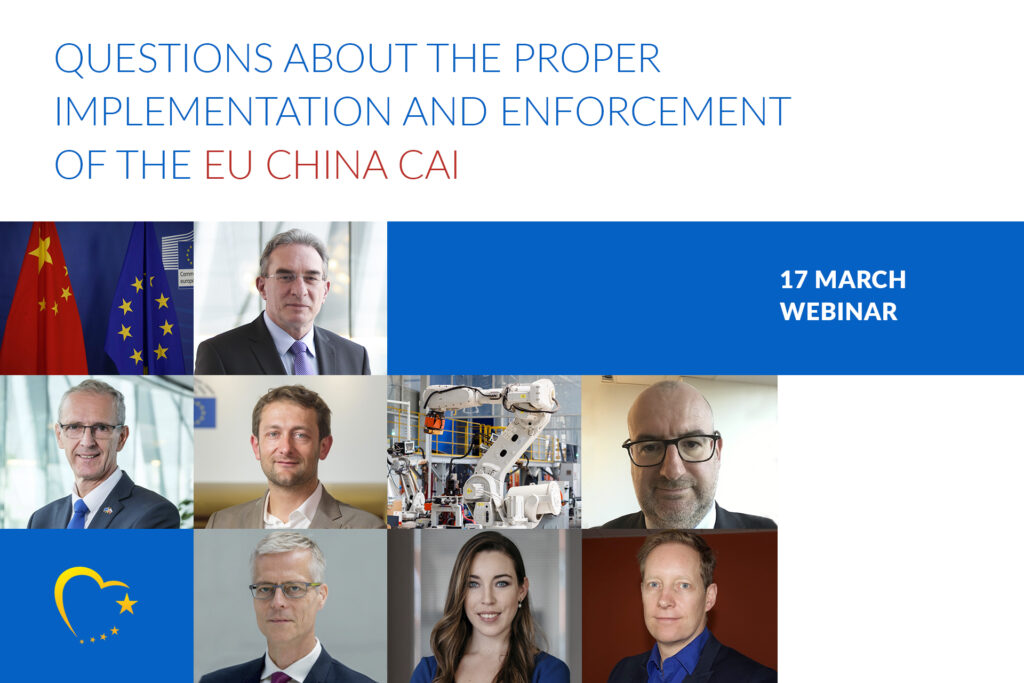
The recently signed political agreement in principle on the EU-China Comprehensive Agreement on Investment (CAI) can be an important development in the overall China strategy of the EU. This agreement could help in rebalancing the relationship, bringing significant gains for EU businesses and investors in market access, level playing field and competitive neutrality. Moreover, the agreement has good language on sustainable development and hence supports the EU’s values-based agenda. The true added-value of this agreement will depend on its effective implementation and proper enforcement. Our discussions will thus focus on this vital aspect, as well as tapping into the expectations and possible concerns of European business associations and SMEs.
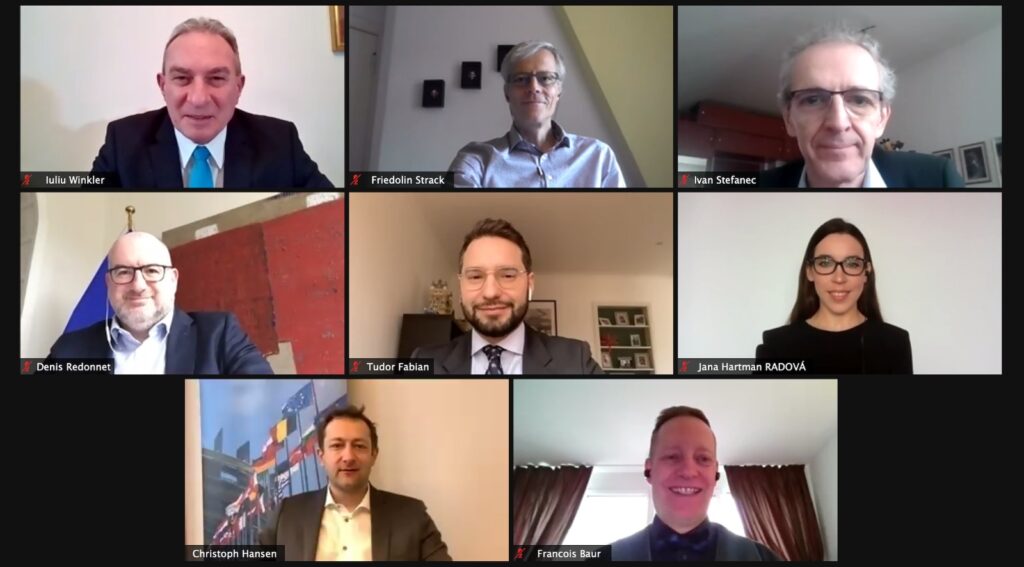
Moderated by Tudor Petru FABIAN, Coordinator Working Group on Trade SME Europe of the EPP, the Virtual Meeting saw such high-level speakers such as Ivan STEFANEC, IMCO, ITRE, AIDA & DROI Committees, President SME Europe of the EPP; Denis REDONNET, Chief Trade Enforcement Officer, DG Trade, European Commission; Christoph HANSEN MEP, EPP Group Coordinator at INTA Committee; Friedolin STRACK, Head of Department International Markets, BDI; Jana HARTMAN RADOVÁ, Head Brussels Office, Confederation of Industry of the Czech Republic Permanent Delegate to BusinessEurope; EESC Member; François BAUR, Head EU Affairs, Economiesuisse; Iuliu WINKLER MEP, Vice-Chair INTA Committee, First Vice-President SME Europe of the EPP.
In his opening remark, Ivan STEFANEC states that the EU trade is really a very powerful tool for promoting European prosperity interests and values. EU is the biggest trade blog in the world, and so it is important to lead it based on the European model of open strategic relationship and fight for a free and fair market that protects and promotes the EU’s core democratic values. Therefore, EU-China CAI must include a strong enforcement mechanism and it has to ultimately ensure fairness, reciprocity and sustainability.
Denis REDONNET sees much potential in this treaty and names two key factors that have to be synchronized, and that plays the most significant role in achieving maximum effectiveness:
- The design of the commitments and the enforcement mechanisms behind the agreement
- The EU’s capacity to action these previsions once the agreement is in place, which is a function of political commitment and resource effort to proper implementation
Christoph HANSEN highlights that it’s key to not forget while analyzing about the CAI being only a part of the toolbox and not the universal solution. He mentions the importance of implementing a credible human rights sanctions regime and the importance of reasonable approach and working together with the Commission when it comes to flanking measures and diligence. Besides, the trilateral work together with Japan and the US on harmful industrial subsidies at the WTO has to be accelerated too. Christoph also brings up the need to put in place a fully pledged China task force.
Friedolin STRACK touched upon such points as the issue of standardization, treaty commitments that give us more power and legal certainty for European SMEs, global dynamics, regional architecture and then investment protection for the strategy ahead. He also draws some attention to the sober analysis of the role of the state in the invasive Chinese economy and the push for careful investment screening. “The times for naive business with China are definitely over”. All in all the EU has to me more solid, resilient and radical in terms of economical relations with China.
On the behalf of Czech industry, Jana HARTMAN RADOVÁ agrees with the points made by the speakers, she sees the CAI as a step in the right direction and also a key component of EU’s broader strategy which is aimed at rebalancing the relationship with China. It can add legal certainty, transparency and help level the playing field for European companies in order to improve conditions for those doing business in China but also for those who wish to enter the market. This agreement opens the door for future dialogue and future negotiation which is why we need to be rather reasonable and pragmatic while working on this topic.
Francois BAUR speaks about the example of Switzerland’s economic relations with China, in particular the short, yet effective investment protection agreement that has been in force for 11 years already. It includes rules on investment protection and on reimbursement in case of export creation as well as the dispute settlement procedure. All other issues are covered by a free trade agreement that contains provisions on trading goods and services, non-tariff barriers to trade, intellectual property protection and sustainable trade and development. Switzerland is a great example to gain experience from since these two agreements have been very beneficial for Swiss business so far and bilateral trade between Switzerland and China has increased significantly in recent years, thus having a great impact on the economy of the country.