

How Can We Make the Digital Services Act Work for SMEs?

European Union has set out the biggest update of digital regulations for around two decades, among which the proposals for a Digital Service Act (DSA) to standardize safety rules for online business. While DSA is mainly designed for big tech, it could potentially have an impact on SMEs and their ability to operate and scaleup freely across Europe if not designed in the right way.
Hosted by Ivan Štefanec MEP, Member of the IMCO Committee, President of SME Europe of the EPP; moderated by Michail Boni, MEP 2014-2019 Senator of SME Europe of the EPP, the virtual meeting saw such high level speakers as Arba Kokalari MEP, IMCO Committee Shadow Rapporteur on the DSA; Henna Virkkunen MEP, ITRE Committee Shadow Rapporteur on the DSA, Co-chair of the SME Circle in the European Parliament; Ricardo Castanhiera, Telecommunication and Digital Counsellor under the Portuguese Chairmanship of the Council of the European Union; Marcin Nowacki, Vice-President of the ZPP – Union of Entrepreneurs & Employers, Member of the European Economic & Social Committee; Victoria de Posson, Senior Manager Public Policy, CCIA Europe.
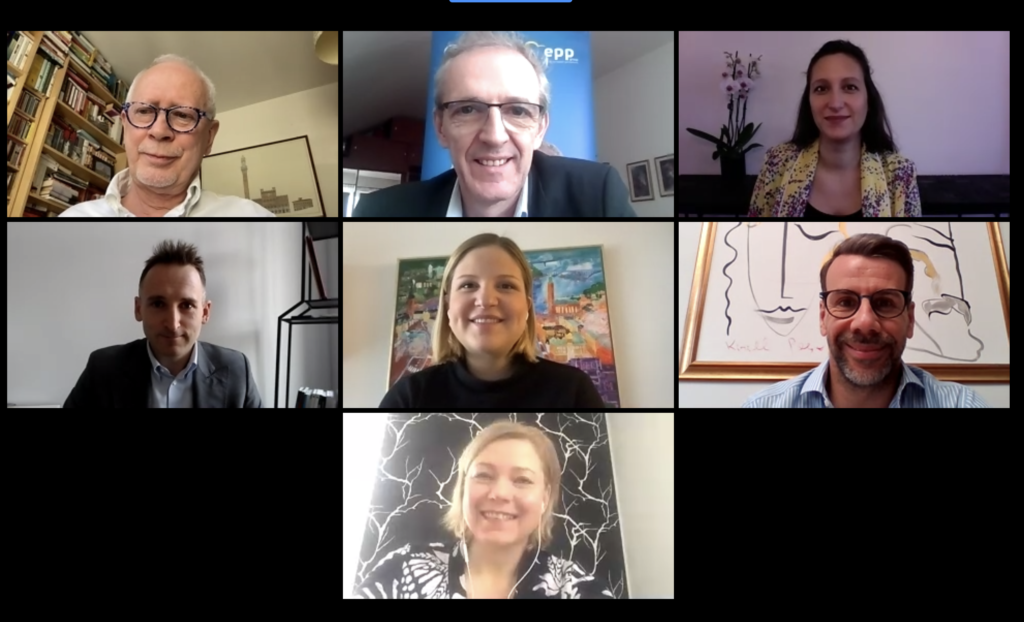
In his opening speech, Ivan Štefanec introduces the topic of the DSA as the key legislation for building the digital single market. It will not only shape the digital market in Europe but also if integrated correctly, it may even set standards for the entire world. Ivan mentioned 3 priorities:
- Better protection of consumers and their fundamental rights
- Establishing a powerful transparency and clear accountability framework for online platforms
- Fostering innovation, growth and competitiveness within the single market
He highlights the importance of making the DSA work for SMEs, not only for big enterprises. He believes that the way to realize that is to harmonize the solutions. That means we have to focus on regulation in particular and also on clear and exact definitions of what’s legal or illegal. The rules, standards and principles for content moderation have to be the same across the entire EU. The complexity of implementing this underlies in avoiding bureaucratic burdens and on the other hand in describing the role of digital service coordinators functioning on the national level.
Arba Kokalari views the DSA as a path to a much more unified framework that will help European tech companies reach new customers and compete globally, it will be a great replacement for the out-of-date e-commerce directive. To make the best of the DSA, though, there are several issues to tackle. According to Arba, first of all the massive spread of illegal content online has to be stopped and the digital “wild west” has to become regulated. Secondly, the unfair competition online in the internal market has to be taken care of since illegal third party companies tend to destroy competition with cheap products. Most importantly, the legislation has to cope with all this without harming the fundamental rights of social media users and without without creating burdens for businesses by overremoval of content. Balance is also a key term here.
Henna Virkunnen points out the need for parliamentary committees to come together to deal with the issues mentioned by Arba and set a level playing field among SMEs operating in European markets and not just focus on the big players. On their side, the ITRE Committee will work for the DSA to be futureproof and effective in the long run. It’s crucially important to look ahead to make sure that this legislation won’t set obstacles for innovations and take in account the problems that are likely to emerge or disappear.
On the hand of the Council, Ricardo Castanhiera brings up a geopolitical risk of having a legal patchwork in Europe with some member states that are coming up with their own legislative solutions on the problems that have been identified in the subject of the DSA. It is of great importance to avoid such fragmentation as it would be a burden for SMEs.
Adding to the discussion, Marcin Nowacki suggests to look carefully for the role and position of digital services coordinators. Even though this is indicated in the proposal, it requires much stronger and deeper analysis. He also goes deeper into the task of setting a level playing field and says that there’s a big obstacle in the shape of the massive effect of China on the EU market.
Victoria de Posson presents her view on some of the issues. Regarding the fragmentation mentioned earlier, she believes that regulations on the EU level would be much more effective to tackle illegal content, activities and services, rather than separate legislations in different countries. Such harmonized framework would also enable SMEs to scale up much easier and not have to comply with many different legislations. Secondly, she suggests that the DSA has to tackle illegal behaviors regardless of platform size or country of origin to maintain a level playing field. In this way we can make the best use of the DSA and eliminate some significant problems of the EU single market.