Breaking Through the Burdens:
Women in Retail – Leadership, Entrepreneurship, Barriers & Opportunities
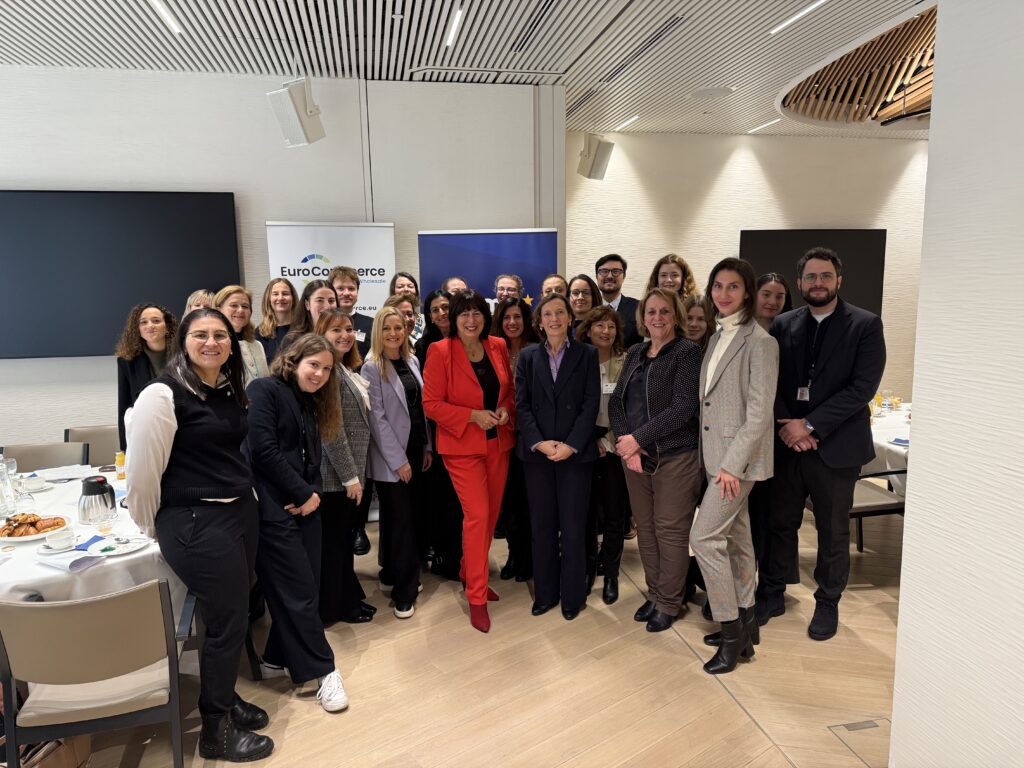
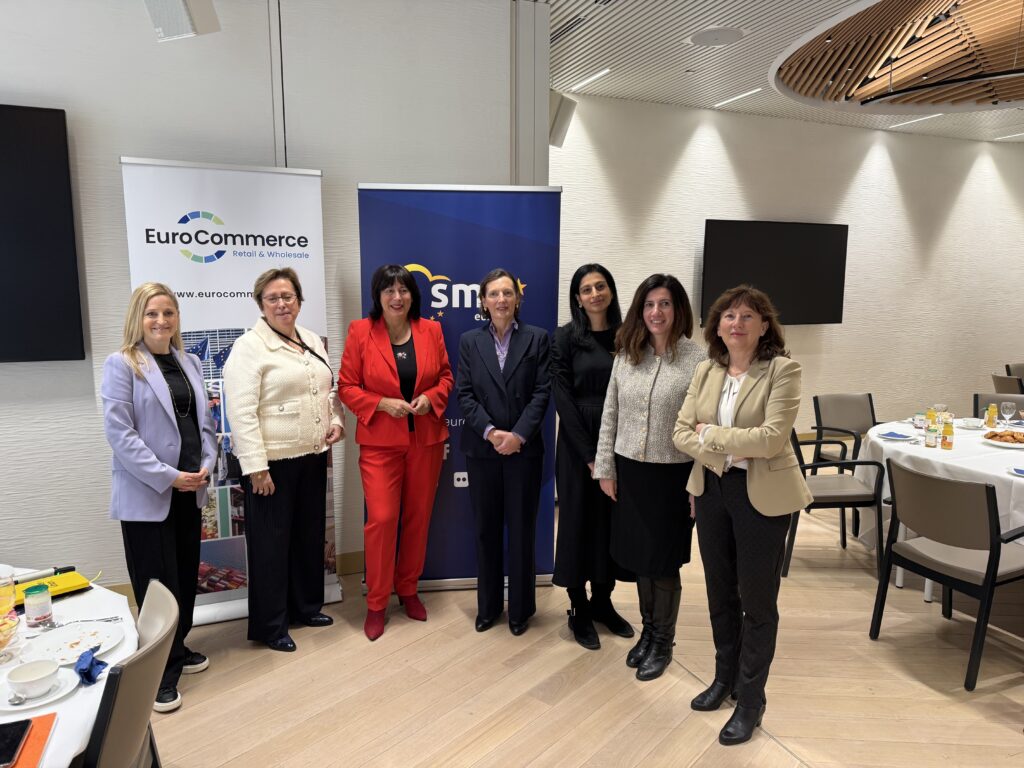
Tuesday, 18 November 2025 was marked by a working breakfast “Breaking Through the Burdens: Women in Retail – Leadership, Entrepreneurship, Barriers & Opportunities” hosted by Marion Walsmann MEP, Board Member of SME Europe, and organised in cooperation with EuroCommerce. The discussion brought together a panel of speakers representing key parts of the retail and wholesale ecosystem: Christel Delberghe (Director General, EuroCommerce), Imelda Vital (Executive Director, Seldia), Nuria Cardoso (Communications Director, ASEDAS), Basak Babaoglu (EU Affairs Manager, METRO AG), and Vanessa Bau (Head of Communication Independent Retail, REWE Group). The event was moderated by Leena Whittaker, Director of Competitiveness, EuroCommerce.
Marion Walsmann welcomed participants and underlined the essential role women play in Europe’s retail and wholesale sector, where they make up 62% of the workforce and represent a significant share of EU entrepreneurs. Despite this strong presence, women face persistent obstacles including limited access to finance, stereotypes in leadership roles, excessive administrative burdens and the difficulty of balancing entrepreneurship with family responsibilities. She stressed that supporting women in retail is not only a question of equality but of strengthening Europe’s competitiveness, as SMEs and local economies rely heavily on the contribution of women entrepreneurs. She called for an EU regulatory environment that encourages entrepreneurship, reduces obstacles, and provides women with the skills, networks and opportunities they need to grow.
Christel Delberghe provided an overview of the scale and importance of the retail and wholesale sector, describing it as a 5-million-businesses sector, dominated by SMEs, employing 26 million people across Europe and contributing €900 billion annually to the EU economy. She noted that while women represent the majority of workers and have strong opportunities in the sector, they continue to face clear barriers: limited entrepreneurial knowledge, prejudice from financial institutions, lack of visibility and support in family businesses, and challenges related to childcare and work–life balance. She called for a broad societal effort involving governments, businesses, education providers and social partners, with early entrepreneurship education, improved digital skills, and stronger support for women entrepreneurs in rural areas as essential elements for long-term change.
Basak Babaoglu presented METRO’s global operations and focused on the company’s internal initiatives to support female leadership. Despite nearly equal gender representation at staff level, the number of women in executive roles varies widely across countries. METRO has developed targeted programmes addressing communication, networking, visibility, and personal branding for women aspiring to leadership positions. A separate programme supports women in store operations, where hours are shaped around consumer expectations and cultural expectations, mobility, child-care and family responsibilities significantly shape career opportunities. She highlighted four obstacles identified by METRO’s own female employees: exclusion from informal networks, family- related challenges, restrictions linked to mobility, and lack of role models. Babaoglu reflected that across the EU there are substantial differences between countries due to cultural norms and social policies and stressed that some barriers require company action, while others demand societal and policy-level change.
Imelda Vital explained the role of the direct-selling sector as a flexible part of retail that allows individuals—particularly women—to run micro-businesses with limited upfront investment. She underlined that direct selling is attractive because it offers flexibility, community support, and training for people with little or no previous entrepreneurial experience. The model is particularly impactful in rural areas or regions with limited employment opportunities. She described how companies and associations provide structured training in interpersonal skills, product knowledge and business basics, enabling many women to build confidence and economic independence. She also highlighted the importance of promoting favourable national frameworks for micro- entrepreneurship, such as reduced contributions and simplified tax systems, and encouraged the EU to replicate successful examples across Member States. The future proposal of a 28th regime can be a great opportunity to offer a simple framework for micro enterprises across the EU if the right governance and requirements are included.
Nuria Cardoso focused on Spanish retail and the franchise model, emphasising its strong contribution to women’s entrepreneurship. Nearly 50% of food-retail franchise stores in Spain are run by women, offering an accessible path to business ownership supported by established systems and proven business concepts. She noted that franchising reduces risk for first-time entrepreneurs and has created thousands of jobs, especially in rural areas where local supermarkets play a central role in community life and territorial cohesion. She described the sector’s “triple transformation” challenges — sustainability, digitalisation, and talent — and stressed that women are increasingly positioned to drive this evolution. Cardoso shared success stories of rural women entrepreneurs who revitalised local economies through small retail and food production businesses, demonstrating the importance of strong local roots and community-based entrepreneurship.
Vanessa Bau discussed the independent retail model within REWE, where entrepreneurs run supermarkets under a cooperative structure with strong support from the central organisation – the so-called partnership model. Women currently represent around 20% of independent retailers, with higher shares among the store staff and store management positions. Bau described new initiatives aimed at encouraging more women to consider owning their own business, including better information on the partnership model, role- model visibility, mentoring and guidance on entrepreneurship, and support during maternity leave, early motherhood and with childcare. She noted that women often underestimate their abilities, express higher fear of failure and face greater uncertainty — particularly during economically unstable periods. Administrative burdens and lack of time for “real retail work” also discourage women. Bau emphasised that digitalisation and simplification of administrative tasks—both at company and regulatory level—would significantly ease women’s path to leadership and independence, where retail is an enabler.