

Virtual Roundtable on the Pharmaceutical Strategy for Europe
On Thursday, May 27th SME Europe of the EPP organized the Virtual Roundtable on the Pharmaceutical Strategy for Europe with Pernille Weiss MEP, Shadow Rapporteur for the EU Pharmaceutical Strategy in the ITRE Committee. Adopted in November 2020, the Pharmaceutical Strategy for Europe seeks to implement a regulatory framework that supports the pharmaceutical sector in building a stronger, a more robust and resilient supply chain to better fulfil the healthcare needs of European citizens. This timely and important digital roundtable brought together policymakers and experts, representing various SMEs of the healthcare supply chain, to highlight the main objectives and targets of the strategy from all point of views.
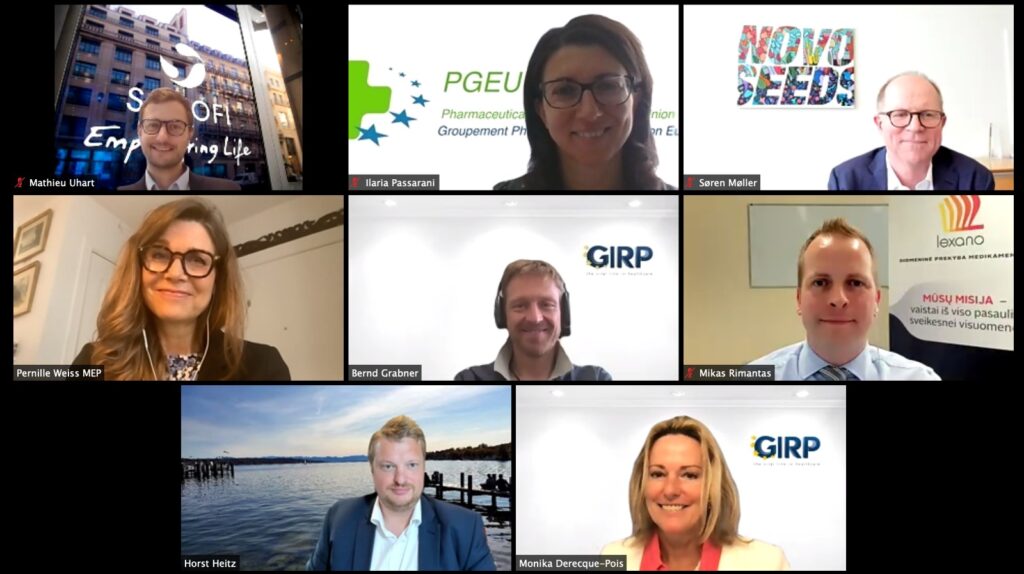
Moderated by Monika Derecque-Pois, Director-General GIRP and Dr. Horst Heitz, the virtual meeting saw high-level speakers such as Pernille Weiss MEP, ENVI & ITRE Committees, ITRE Committee Shadow Rapporteur for the EU Pharmaceutical Strategy, Board Member of SME Europe of the EPP; Ilaria Pasarani, Secretary General, PGEU; Bernd Grabner, President, GIRP; Board Member of Jacoby-GM Pharma GmbH; Mathieu Uhart, Director Corporate Public Affairs Europe, Sanofi; Søren Møller, Managing Partner, Novo Holding; Mikas Rimantas, Business Development Director, LEXANO.
MEP Pernille Weiss opened the floor stating that it is necessary to cooperate with the industry to create a bulletproof draft for the EU Pharmaceutical strategy and more opportunities for European SMEs.
Ilaria Pasarani spoke about the importance of ensuring greater access and availability of medicines for patients. She also commented: “We need to involve more community pharmacies in the EU Pharmaceutical strategy, for example through innovative digital technologies”.
Bernd Grabner stated that pharmaceutical wholesalers should be part of the critical and essential infrastructure. “There needs to be an European approach to healthcare and its distributors.”
Mathieu Uhart suggested that the priorities for the EU Pharmaceutical strategy are securing supply chains, making them resilient, creating a strong manufacturing ecosystem for the future and accelerating access to innovation for patients and distributors.
“The pharmaceutical value chain is based on biotech social contracts,” stated Søren Møller. “It has enormous potential for innovation, starting from academic research, and for benefitting patients and society in Europe.”
Mikas Rimantas supported the idea of parallel trade. It supports drug access and connects distribution where there are gaps. He believes that his would help fight pharmaceutical shortages, which are especially difficult to deal with for smaller countries.