

SMEs & Platform Work:
Balancing Job Creation, Innovation & Social Protection
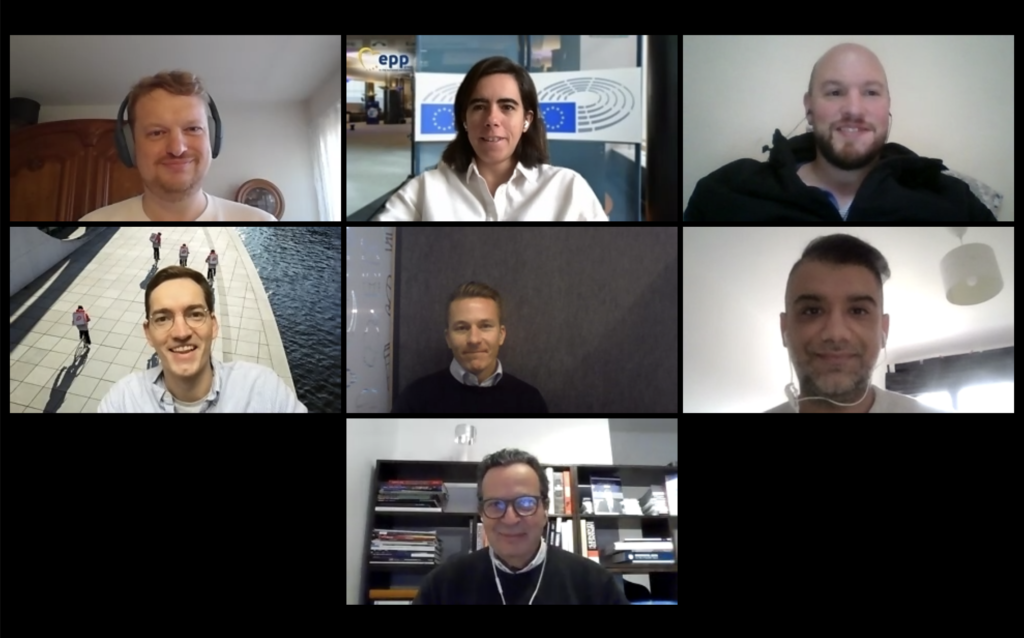
Friday, the 3rd of December 2021, SME Europe of the EPP organized a webinar on SMEs & Platform Work: Balancing Job Creation, Innovation and Social Protection.
The event came in the wake of the European Commission upcoming proposal on the European Commission on platform work, with the objective of ‘improving the conditions of platform workers’ and brought together politicians, policy and industry experts, as well as workers to have an open dialogue and exchange on learnings and further ideas.
Hosted by Isabel BENJUMEA BENJUMEA MEP, Board Member of SME EUROPE of the EPP and moderated by Dr. Horst HEITZ Executive Director of SME Europe of the EPP, the webinar assembled a high-level expert panel comprised of Christian POPPE, Manager Global Public Policy and Government Affairs, Delivery Hero, Adrian PORRES GONZÁLEZ, Executive Board Member, Association of Professional Autonomous Riders, Samuel LAURINKARI, Head of Global Public Policy, Wolt, Mujahid ZAMAN, Professional LVC driver, a video intervention by Sylvie JOSEPH, Secretary General, Drivers Association (France), while the conclusions where expertly drawn by Georgios KYRTSOS MEP, Board Member of SME Europe of the EPP.
Isabel BENJUMEA BENJUMEA MEP introduced the topic of platform work by pointing to the actual situation in Spain, where restrictive regulations have severe consequences of unlimiting the capacity of platforms to hire riders, forcing employers to have full employees, hence loosing flexibility, bringing job shortage with severe impact on small businesses.
Adrian PORRES GONZÁLEZ gave an overview of the Rider Law in Spain and detail the context in which the companies are working nowadays, he advocated for a mixed model, where everybody could benefit, by pointing to the Association of Professional Autonomous Riders efforts and struggles to fight the limitations of the law and the devastating consequences this restrictive law has for labour market, small and big businesses alike.
Christian POPPE welcomed the European Commission initiative stressing that the upcoming proposal should enable governments and platforms to adopt concrete measures to improve the working conditions of platform workers. He referred to good models already in place that proved their efficacy. As an example, he pointed to Greece’s flexible model that introduced very smart provisions for workers on platforms which specify workers can be either employees or independent contractors, hence having their own choice.
Samuel LAURINKARI mentioned one of the criteria used in the EC assessment is pricings: should self-employed be able to freely price their services so should the fact that a platform sets the price of a service provider be considered an indication of employment. If platforms lose the ability to control the pricing on the platform it leads to price competition between the self-employed in the platform economy which will push earnings down.
Mujahid ZAMAN presented the situation of his two employees, LVC drivers, forced out of their jobs following a court ruling against UBER platform demonstrating how national regulations of platforms (or lack of them) can direct impact the labour market.
Sylvie JOSEPH raised four matters concerning the situation of VTC drivers and delivery drivers in France. She described the role of the association in representing platform workers, voiced the needs and demands of platform workers, detailed on the measures taken by France to improve the situation of drivers, and mentioned that reclassification is not the best and only way to improve conditions for drivers.
Georgios KYRTSOS MEP remarked that platforms are developing very fast, with Spain and Greece being special cases, since they have high unemployment rates, Spain being the only country that opted for a rigid model of control, and we should avoid duplicating this model at the EU level. He mentioned the platforms are beneficial to SMEs and declared himself for the flexible approach with increasing social responsibilities.