

Accelerating Europe’s Energy Infrastructure:
CEF, Grid Package and SME Competitiveness
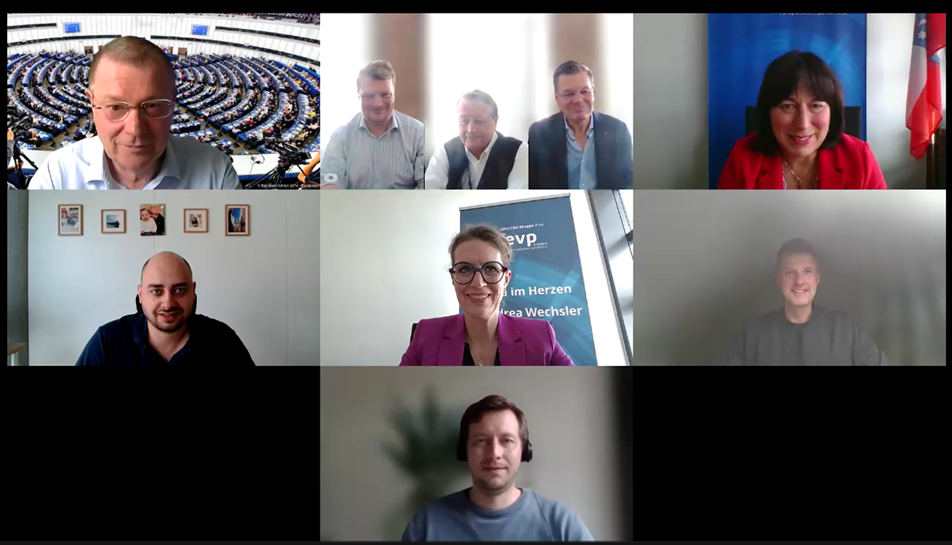
On 17 June, the SME Europe Working Group Energy & Infrastructure (ENIS) and MIT Belgium held a joint meeting on the future of European energy infrastructure, the Connecting Europe Facility (CEF), and the upcoming Grid Package. The discussion focused on how Europe can strengthen investment in electricity, hydrogen, CO₂ and broader energy infrastructure while accelerating permitting procedures and improving industrial competitiveness.
The meeting was opened by Dr. Horst Heitz, Secretary General of SME Europe, Bastian Biermann, Chair of MIT Belgium, and Dr. Markus Pieper, Senator and Board Member of SME Europe and Chair of the Working Group Energy & Infrastructure. Prof. Dr. Andrea Wechsler MEP delivered the keynote and provided a detailed political assessment of the ongoing European Parliament discussions on CEF Energy, the next Multiannual Financial Framework and permitting reform.
A central message of the exchange was that Europe’s energy transition will only be credible if infrastructure expansion becomes faster, more investment-ready and technologically open. Dr. Pieper underlined that the EU must substantially strengthen investment in energy grids and interconnectors under the next MFF. He stressed that this must not be limited to electricity grids, but must also include hydrogen, CO₂ networks, bioenergy and other relevant infrastructure. The CEF Energy budget increase from around EUR 5.8–6 billion to almost EUR 30 billion was welcomed as an important step, but participants warned that CEF must remain focused on strategic European infrastructure and must not become a substitute for national budget shortfalls.
Prof. Dr. Wechsler emphasized that financing and permitting are the decisive tests for Europe’s electrification and decarbonisation agenda. Without faster permitting, transmission lines, offshore grids, hydrogen backbones, interconnectors and smart distribution infrastructure cannot be delivered at the scale required. She made clear that the Commission proposal on permitting acceleration remains insufficient from an EPP perspective, especially if it relies mainly on tacit approval. The EPP position aims to go further by shortening procedural deadlines, improving implementation timelines, reviewing permitting thresholds and strengthening the concept of overriding public interest for strategic energy infrastructure.
The discussion also highlighted the link between energy infrastructure and competitiveness for SMEs. Participants stressed that high energy costs remain a direct threat to European industry, especially in rural and manufacturing regions. Prof. Dr. Wechsler noted that grid investment will not reduce prices immediately, since infrastructure requires upfront costs and may affect network tariffs. However, insufficient grids are also costly because they create congestion, curtailment, redispatch costs, delays in industrial electrification and higher system costs. The long-term effect of infrastructure investment is therefore essential for reducing structural energy-cost pressure and improving resilience.
Several speakers pointed to the importance of national implementation. While the EU can provide frameworks through CEF, TEN-E, the Grid Package and ACER coordination, member states must accelerate permitting and planning, create predictable grid-connection timelines, improve queue management, digitise administrative procedures and strengthen permitting capacity. The discussion made clear that national governments should not wait for EU legislation where faster action is already possible.
A further focus was the role of AI and digital tools in permitting. Bastian Biermann raised the question of transparency and non-discrimination in AI-supported administrative decisions. Prof. Dr. Wechsler explained that AI tools may become necessary to help authorities process large volumes of objections and applications, especially where AI-generated objections could delay infrastructure projects. However, she stressed that final safeguards should remain anchored in the broader EU legal framework, including the AI Act and GDPR, particularly where decisions affect rights and obligations.
The meeting also addressed electricity-market design, bidding zones, storage and seasonal energy security. Participants discussed whether national borders still provide an adequate basis for electricity-market zones and whether more flexible cross-border bidding-zone models could improve competition. At the same time, concerns were raised about the potential impact on industrial regions. On storage, the debate distinguished between short-term battery storage and seasonal storage, with strong emphasis on hydrogen, renewable gases, biomethane, synthetic fuels and chemical-sector capabilities as key components of long-term energy resilience.
Private investment was identified as a critical condition for success. Public funding alone will not close Europe’s infrastructure investment gap. Prof. Dr. Wechsler underlined that EU energy legislation must reduce permitting risk, regulatory risk, revenue uncertainty and litigation risk in order to create bankable conditions for private capital. The broader Capital Markets Union agenda was also identified as relevant for mobilising investment into energy infrastructure.
The meeting concluded with broad agreement that Europe needs a more integrated, technology-open and investment-friendly energy infrastructure strategy. CEF Energy and the Grid Package are central instruments, but their effectiveness will depend on whether EU funding, permitting acceleration, national implementation, private investment and market design reforms are aligned. For SMEs, the political priority remains clear: secure, affordable and reliable energy infrastructure is not only a climate issue, but a core condition for competitiveness, industrial resilience and Europe’s strategic autonomy.